
7 Amazon Support Issues Your Team Should Be Tracking
9/13/2026
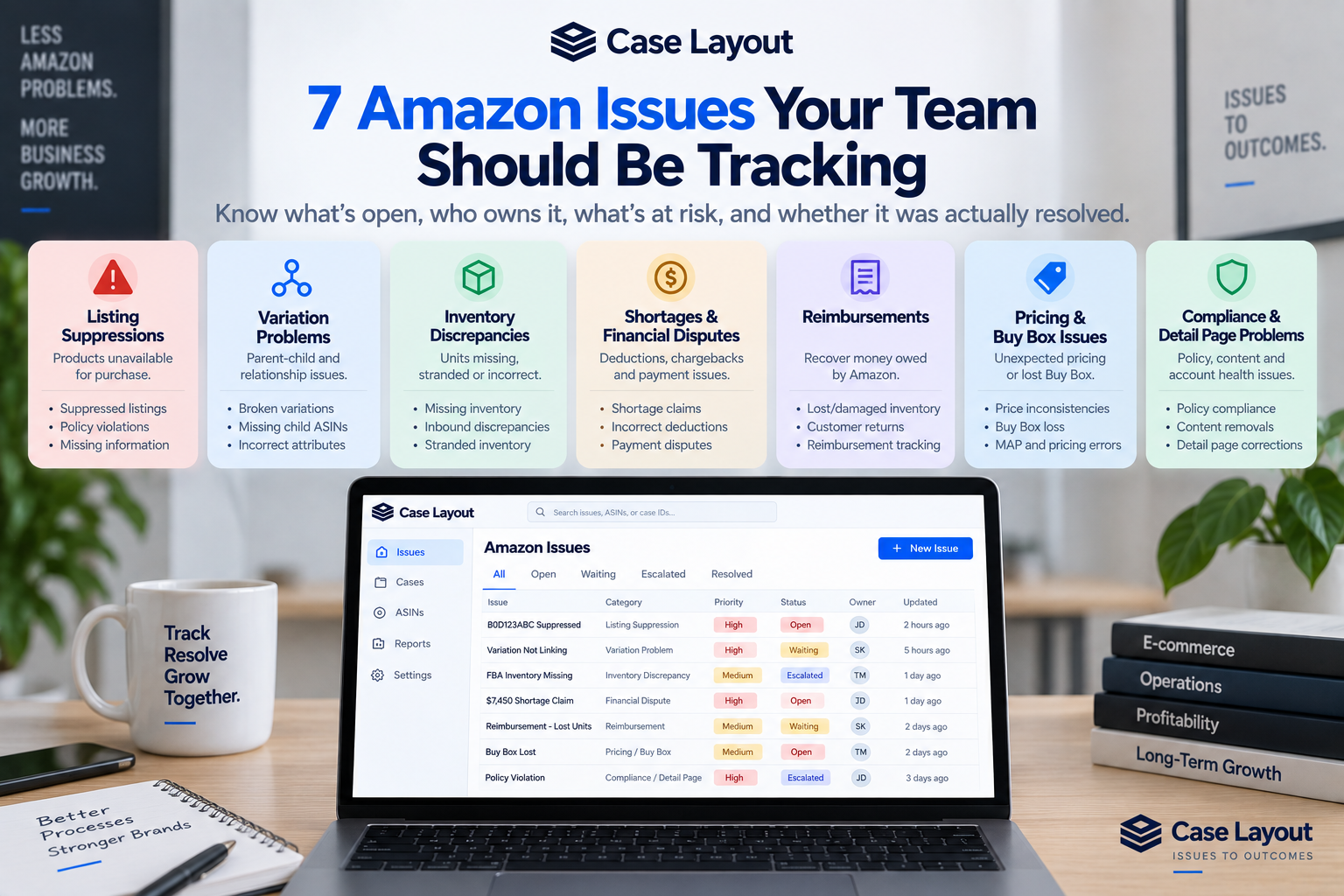
Amazon businesses can generate a surprising number of support cases. Some are simple requests that get resolved quickly. Others represent problems that can directly affect sales, inventory, profitability, customer experience, or account operations.
The mistake is treating all of those cases the same.
A minor content correction on a low-volume product shouldn't necessarily receive the same attention as a suppressed top-selling ASIN. A small administrative request isn't equivalent to thousands of dollars in unrecovered funds.
The more useful approach is to identify the business issue behind the Amazon case and determine which types of issues deserve structured tracking from the moment they're discovered until the final outcome is verified.
While every Amazon business is different, there are seven categories of issues that are particularly important to track.
1. Listing Suppressions
Listing suppressions should be near the top of almost any Amazon team's priority list because they can have an immediate impact on sales.
When an important ASIN becomes unavailable, every hour the problem remains unresolved can represent potential lost revenue.
The support case number alone doesn't give your team enough information to understand the problem.
For a listing suppression, consider tracking:
- Affected ASIN or ASINs
- Date and time the suppression was discovered
- Reason provided by Amazon
- Estimated sales impact
- Assigned owner
- Related Amazon case IDs
- Documentation submitted
- Actions already attempted
- Current status
- Next follow-up date
- Date the listing was restored
For important products, it may also be useful to estimate the potential revenue exposure.
If an ASIN normally generates $3,000 per day and has been unavailable for four days, that context immediately tells the organization why the issue deserves attention.
The issue should remain open until someone verifies that the product is actually purchasable again.
Amazon saying the listing has been restored isn't the same as your team confirming that customers can buy it.
2. Variation Problems
Variation issues can be some of the most frustrating Amazon problems because what appears to be one catalog issue can affect an entire product family.
A parent-child relationship may break. Child ASINs may become separated. Products may appear under the wrong variation. A variation theme may change or disappear.
Your team opens a case.
Amazon responds.
The relationship still isn't correct.
Another case gets opened.
Eventually, one variation problem can generate several Amazon case IDs.
This is exactly why tracking the underlying issue matters.
Instead of treating every case as a separate problem, create one issue such as:
12-Pack Product Family — Variation Broken
Then connect every related Amazon support case to that issue.
For variation problems, consider tracking:
- Parent ASIN
- Affected child ASINs
- Expected variation structure
- Current incorrect structure
- Date the issue was discovered
- Related case IDs
- Screenshots
- Flat files or supporting documentation
- Changes attempted
- Amazon responses
- Escalation history
- Final resolution
Historical tracking becomes particularly valuable with variation problems because they can recur.
If the same product family breaks six months later, your team shouldn't necessarily have to rediscover everything it learned the first time.
The previous issue can show which approaches failed, what Amazon requested, and what ultimately corrected the relationship.
3. Inventory Discrepancies
Inventory issues can create both revenue and cash-flow problems.
Your company may have already paid to manufacture, purchase, and transport inventory, but if those units aren't correctly reflected or available within Amazon's systems, they may not be generating sales.
Inventory-related issues can include discrepancies involving inbound shipments, missing units, stranded inventory, unavailable inventory, incorrect quantities, or other situations where Amazon's records don't match what your organization expects.
These issues often require information from multiple sources.
Operations may have shipping records. Finance may have invoices. The Amazon team may have shipment information. Supporting documentation may exist in several different systems.
For inventory discrepancies, consider tracking:
- Affected SKU or ASIN
- Shipment or reference information
- Number of units involved
- Estimated inventory value
- Date discovered
- Expected inventory
- Amazon-reported inventory
- Supporting documentation
- Related Amazon case IDs
- Assigned owner
- Current status
- Final quantity recovered or corrected
The financial context matters.
An inventory discrepancy involving 10 units and one involving 10,000 units are both inventory issues, but they shouldn't necessarily have the same priority.
4. Shortages and Financial Disputes
Financial issues deserve particularly careful tracking because the outcome can be measured directly in dollars.
A support case may involve a shortage, deduction, payment discrepancy, or another financial issue your organization believes Amazon needs to correct.
The biggest mistake is allowing the support process itself to become the measure of success.
Your goal isn't simply to get Amazon to respond.
Your goal is to recover the money your business is owed.
For financial disputes, consider tracking:
- Original amount in dispute
- Reason for the dispute
- Relevant transaction or purchase order
- Documentation submitted
- Date the issue was opened
- Related Amazon case IDs
- Amazon's response
- Amount approved
- Amount recovered
- Remaining amount outstanding
- Assigned owner
- Final verification
This makes the actual business outcome visible.
Suppose your company disputes $20,000 and Amazon eventually approves $14,000.
If your internal tracker simply says "Resolved," you're losing important information.
A better record shows the original exposure, what was recovered, and what remained unresolved.
5. Reimbursements
Reimbursements deserve their own attention because there can be a gap between Amazon approving a reimbursement and your business actually receiving it.
Imagine your team identifies a $5,000 reimbursement opportunity.
You open a case, provide the required documentation, and Amazon eventually confirms that the reimbursement has been approved.
The support case closes.
It's tempting to consider the work finished.
But someone should verify the financial transaction.
For reimbursement issues, consider tracking:
- Expected reimbursement amount
- Reason for reimbursement
- Date requested
- Related Amazon case IDs
- Amount approved
- Expected payment timing
- Amount actually received
- Date received
- Remaining balance
- Verification status
The internal issue should remain open until the expected financial outcome has been confirmed.
This creates a simple but important control.
Approved doesn't necessarily mean recovered.
6. Pricing and Buy Box Issues
Pricing issues can affect sales very quickly.
A product may lose the Buy Box, encounter a pricing-related suppression, display an unexpected price, or experience another problem that reduces its ability to convert.
These situations can also become difficult to investigate because several factors may be involved.
Your team may review your own pricing, competitive offers, channel pricing, promotional activity, and Amazon's responses while trying to understand what changed.
For pricing and Buy Box issues, consider tracking:
- Affected ASIN
- Date the issue began
- Expected price
- Observed price or issue
- Buy Box status
- Estimated revenue impact
- Internal pricing changes
- Related Amazon case IDs
- Screenshots
- Actions attempted
- Date resolved
- Final resolution
Historical information can become valuable if the same product repeatedly experiences similar pricing problems.
Instead of treating each event as unrelated, your team can review previous issues and look for patterns.
7. Compliance and Detail Page Problems
Compliance and detail-page issues can become particularly complicated because they may require participation from several departments.
A compliance request might require documentation from legal, regulatory, product development, operations, or another internal team.
A detail-page problem might involve content, attributes, images, product information, or contributions from multiple sources.
These issues can create a lot of communication outside the Amazon support case itself.
For compliance and detail-page problems, consider tracking:
- Affected ASINs
- Issue category
- Amazon's stated reason
- Date discovered
- Required documentation
- Internal departments involved
- Documents submitted
- Related Amazon case IDs
- Actions taken
- Escalation history
- Current status
- Verification of final correction
Centralizing that history makes it much easier for someone to understand what happened later.
Otherwise, critical information may remain spread across Amazon, email conversations, shared drives, internal messages, and individual employees' notes.
Don't Stop at the Seven Categories
These seven categories aren't meant to represent every problem an Amazon business can encounter.
Your organization may need additional categories based on how it operates.
You might track issues involving:
- Purchase orders
- Shipping
- Product content
- Brand Registry
- Account health
- Returns
- Chargebacks
- Customer experience
- Advertising-related dependencies
- Operational integrations
- Other marketplace-specific problems
The exact taxonomy matters less than consistency.
If everyone on your team categorizes issues differently, the historical data becomes much less useful.
Define a manageable set of categories that reflects the problems your organization actually encounters and use them consistently.
Categories Help You Prioritize Work
Once issues are categorized, your team can start doing more than simply counting cases.
Suppose you have 40 unresolved Amazon issues.
Knowing that there are 40 issues isn't particularly actionable.
Now imagine you can see that:
- 8 are listing suppressions
- 6 are variation problems
- 10 involve inventory
- 5 involve financial disputes
- 4 involve reimbursements
- 3 involve pricing
- 4 involve compliance or detail-page problems
You now have a much clearer view of what's happening operationally.
Add business impact and the picture becomes even more useful.
Perhaps only eight of the 40 issues account for most of the revenue or financial exposure.
Those are probably the issues your team should focus on first.
Track Priority Separately From Issue Type
Issue category and priority shouldn't be the same thing.
Not every listing suppression is automatically your highest priority.
A suppressed ASIN generating $50 per week may have less immediate business impact than an inventory problem affecting thousands of units of your best-selling product.
Your team can consider factors such as:
- Revenue exposure
- Financial exposure
- Inventory affected
- Number of ASINs involved
- Customer impact
- Compliance risk
- Age of the issue
- Strategic importance
This creates a more rational way to prioritize Amazon support work.
Instead of the loudest or newest problem always receiving attention first, the team can focus on the issues creating the greatest business risk.
Every Issue Should Have an Owner
Regardless of category, every significant issue should have one primary owner.
Multiple employees can contribute, but someone should ultimately be accountable for moving the issue toward resolution.
The owner should know:
- What happened
- Why it matters
- Which Amazon cases are related
- What has already been attempted
- What Amazon has said
- What needs to happen next
- When the issue should be reviewed again
- What outcome qualifies as resolved
Clear ownership becomes increasingly important as Amazon teams grow.
Without it, an issue can sit unresolved because everyone assumes someone else is handling it.
Every Issue Should Have a Next Action
Status alone isn't enough.
An issue marked Waiting on Amazon still needs a next action.
Maybe the team should follow up tomorrow.
Maybe it should be escalated if no response is received by Friday.
Maybe Amazon requested documentation from finance.
Maybe the listing needs to be checked again after a catalog update.
Whatever the situation, someone should be able to look at an unresolved issue and immediately understand what happens next.
This is the difference between maintaining a list of cases and managing a workflow.
Track Issues Through Verified Resolution
The final principle applies to every category on this list.
Don't automatically consider an issue resolved because Amazon closed the support case.
Verify the business outcome.
For a listing suppression, confirm that the ASIN is purchasable.
For a variation issue, confirm that the product family displays correctly.
For inventory, verify the quantities.
For a financial dispute, confirm the amount recovered.
For a reimbursement, verify the payment.
For pricing, check the actual customer experience.
For compliance or detail-page problems, confirm that the expected correction has occurred.
Amazon's case status is useful information.
Your organization's issue status should reflect the actual business outcome.
Your Amazon Support History Should Tell You Something
The biggest benefit of categorizing and tracking these issues may appear over time.
After several months, your organization should be able to answer questions such as:
- Which Amazon problems happen most frequently?
- Which ASINs generate the most support activity?
- Which categories take longest to resolve?
- Which issues most frequently require escalation?
- Where is the greatest financial exposure?
- Which problems repeatedly return after being marked resolved?
- Which solutions have worked before?
Those questions turn Amazon support history into operational intelligence.
If the same variation issue happens five times, that's worth knowing.
If one product generates repeated suppressions, that's worth investigating.
If one type of financial dispute consistently requires the same escalation path, that history can help the next person resolve it faster.
The goal isn't simply to document Amazon problems. It's to learn from them.
Build a Better Record of Your Amazon Issues
This is one of the reasons I built Case Layout.
Amazon support cases are important, but the case ID alone doesn't tell the complete story.
Case Layout gives teams a centralized place to organize the underlying business issue, categorize it, assign ownership, connect related Amazon cases, preserve documentation, track business impact, maintain history, and verify the final resolution.
Over time, that creates something much more valuable than a spreadsheet filled with support case numbers.
It creates a searchable history of what went wrong, what it affected, what your team did about it, and how the problem was ultimately resolved.
Because the most useful Amazon support system isn't the one that tells you how many cases you've opened.
It's the one that helps your team understand which problems matter and make sure they actually get fixed.