
How to Measure Whether Your Amazon Support Process Is Actually Working
9/13/2026
Most Amazon teams can tell you how many support cases they have open.
They may also know how many cases were opened last month, how many Amazon closed, and which employees are managing them.
Those numbers are useful, but they don't necessarily answer the question that matters:
Is our Amazon support process actually working?
Closing 100 Amazon cases sounds productive. But what if 20 of the underlying problems weren't actually resolved? What if another 15 required new cases a week later? What if your team recovered only a portion of the money it was pursuing?
Amazon support performance shouldn't be measured solely by case activity.
It should be measured by business outcomes.
Case Volume Is an Activity Metric
The number of Amazon cases your team opens can tell you something about workload.
It doesn't necessarily tell you anything about effectiveness.
Imagine two Amazon teams.
Team A opens 200 support cases in a quarter.
Team B opens 100.
At first glance, Team A may appear to be doing more work.
But suppose Team A frequently opens multiple cases for the same unresolved problem while Team B resolves most issues with fewer support interactions.
Which team has the better process?
You can't answer that by looking at case volume.
Opening a case is an activity. Resolving the underlying problem is an outcome.
Your reporting should distinguish between the two.
Start by Measuring Issues Instead of Just Cases
One of the most important changes an Amazon team can make is separating Amazon cases from business issues.
Imagine a listing suppression requires four different Amazon support cases before it's finally corrected.
Amazon sees four cases.
Your business experienced one issue.
If your reporting counts each case independently, the data can become misleading.
You might report:
4 Amazon cases closed
when the actual business outcome was:
1 listing suppression resolved
Both pieces of information can be useful, but they measure different things.
The issue should be the primary unit when you're trying to understand whether your support operation is solving business problems.
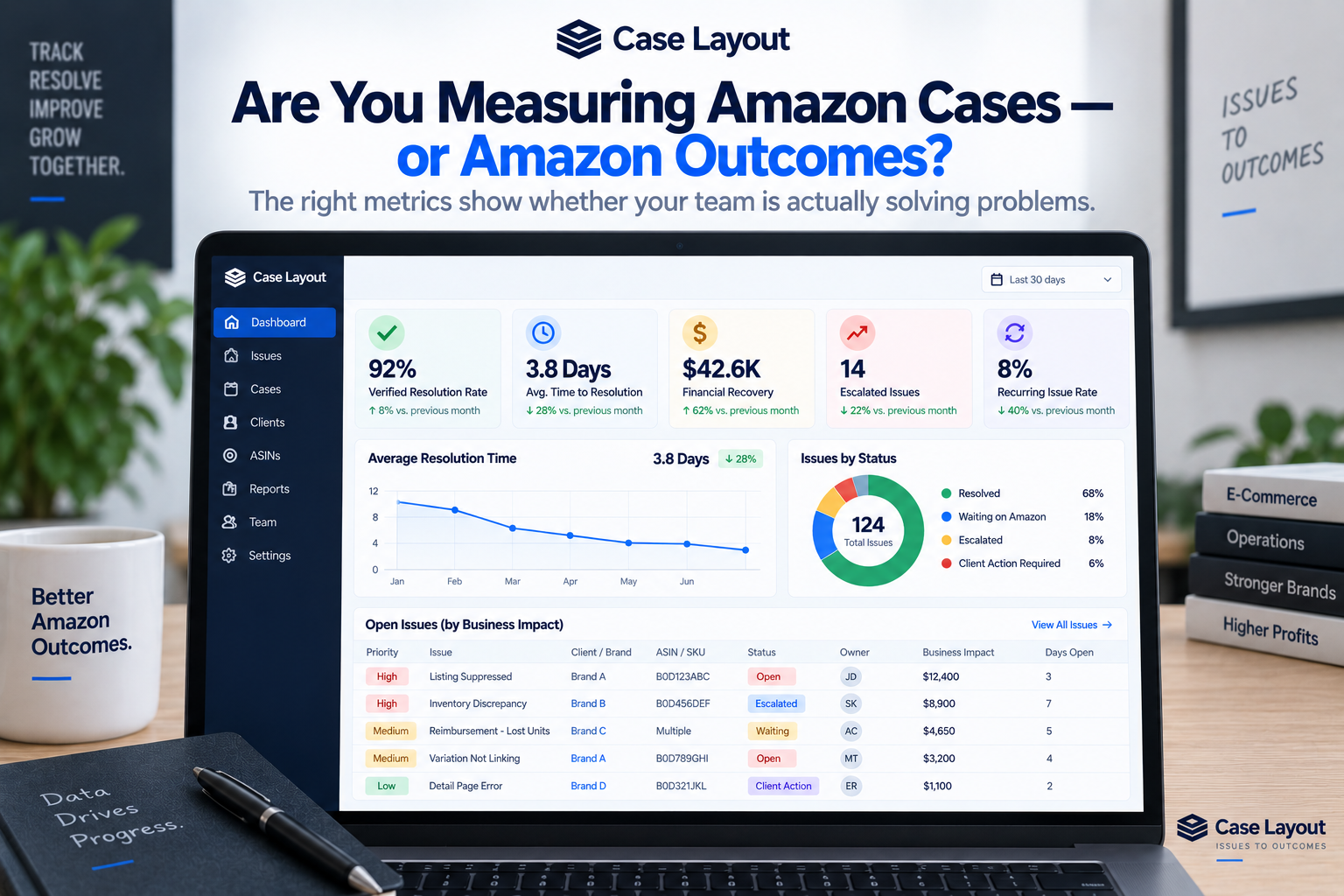
Metric 1: Verified Resolution Rate
One of the most valuable metrics is your verified resolution rate.
This measures the percentage of issues that were not simply closed by Amazon, but independently confirmed by your team as actually resolved.
For example, suppose your team worked on 100 Amazon issues during a period.
Amazon closed the associated cases for 95 of them.
Your team then verified that the expected business outcome actually occurred for 88.
Your verified resolution rate would be based on those 88 confirmed outcomes rather than the 95 cases Amazon marked closed.
Why does this matter?
Because Amazon closing a case doesn't always mean the problem disappeared.
Verification should depend on the issue.
- For a listing suppression, confirm the ASIN is purchasable.
- For a variation problem, confirm the relationship displays correctly.
- For an inventory issue, confirm the expected inventory is available.
- For a reimbursement, confirm the funds were actually received.
- For a catalog correction, confirm the requested change is live.
A closed case measures Amazon's workflow. A verified resolution measures your business outcome.
Metric 2: Average Time to Resolution
The next important metric is average time to resolution.
This measures how long an issue remains open from discovery through verified resolution.
For example:
Issue identified: September 1
Amazon case opened: September 1
Amazon says resolved: September 4
Your team verifies resolution: September 5
The actual time to resolution is approximately four days.
Why not simply measure how long the Amazon case remained open?
Because the business issue may exist before the case is created and may remain unresolved after Amazon closes it.
The issue lifecycle is what matters.
Tracking resolution time can help you identify which types of Amazon problems consume the most time.
You may discover that listing suppressions average two days while variation problems average nine days.
That information can help your team improve processes and set better expectations.
Metric 3: Time to First Action
How quickly does your team respond after discovering a problem?
This can be particularly important for high-impact issues.
Suppose your highest-volume ASIN becomes suppressed at 9:00 a.m.
Your team doesn't discover or begin addressing the issue until 3:00 p.m.
Six hours of the resolution timeline occurred before anyone started working on the problem.
Tracking time to first action can help identify internal delays.
For important issues, you may want to know:
- When was the issue discovered?
- When was an owner assigned?
- When did the first internal action occur?
- When was the first Amazon case opened?
This is especially useful for teams managing large catalogs where problems may otherwise sit unnoticed.
Metric 4: Average Number of Cases per Issue
This is where separating cases from issues becomes particularly useful.
Suppose your team resolved 50 business issues last month but opened 110 Amazon cases to do it.
That means the average issue required more than two support cases.
That isn't automatically bad. Some Amazon problems legitimately require multiple cases or escalation paths.
But the metric can reveal patterns.
Perhaps variation issues consistently require four cases.
Maybe inventory problems are usually resolved in one.
Perhaps a certain type of support request repeatedly gets closed before resolution.
Your team can begin investigating why.
A high number of cases per issue may indicate:
- Difficult Amazon support paths
- Incomplete initial documentation
- Cases being closed prematurely
- Incorrect support categories
- Recurring escalation requirements
- Complex problems involving multiple Amazon teams
The number becomes more useful when viewed by issue category.
Metric 5: Escalation Rate
How often does your team need to escalate Amazon issues?
If 10% of your issues require escalation, that tells you something.
If 70% require escalation, that tells you something very different.
Track the percentage of issues that move beyond your standard support process.
Then break that information down by category.
You may discover:
- Listing suppressions rarely require escalation.
- Variation issues frequently require escalation.
- Financial disputes take longer but have a lower escalation rate.
- A specific type of catalog problem repeatedly stalls in normal support.
The goal isn't necessarily to eliminate escalation.
Some problems require it.
The goal is to understand where and why escalation is happening.
Metric 6: Recurring Issue Rate
One of the most valuable questions your Amazon support history can answer is:
How often do supposedly resolved problems come back?
Imagine your team resolves a variation issue.
Two months later, the same relationship breaks again.
The team fixes it.
Three months later, it happens again.
If those events are tracked only as individual Amazon cases, they may appear unrelated.
When they're connected through ASINs, issue categories, and historical records, the pattern becomes much easier to identify.
A recurring issue rate can help your team distinguish between:
We fixed the symptom
and:
We fixed the underlying problem.
Recurring problems may reveal larger issues involving catalog data, internal processes, integrations, inventory workflows, or other root causes.
Metric 7: Financial Recovery
Financial Amazon issues deserve their own performance metric.
Suppose your team identifies $100,000 in shortages, reimbursements, or other recoverable amounts during a quarter.
How much did you actually recover?
If Amazon approves $90,000 but your company ultimately receives $82,000, those numbers should not be treated as identical.
A useful financial recovery record might track:
- Original amount in dispute
- Amount requested
- Amount approved
- Amount actually recovered
- Amount still outstanding
- Date recovered
- Number of related cases
- Time to recovery
Now leadership can see the actual financial outcome of the support process.
The goal isn't to close reimbursement cases. The goal is to recover the money.
Metric 8: Business Impact Resolved
Some of the most important Amazon issues don't involve a direct reimbursement.
They involve protecting revenue.
A suppressed ASIN might represent thousands of dollars in potential daily sales.
An inventory issue could make hundreds of units unavailable.
A broken variation could affect conversion across an entire product family.
Tracking business impact gives your team a better understanding of what it accomplished.
For example, instead of reporting:
23 issues resolved
you might eventually be able to report:
23 issues resolved, including 5 revenue-impacting listing problems, 1,800 units of inventory corrected, and $32,000 in financial recoveries.
That tells a much stronger operational story.
Metric 9: Issue Age
Every Amazon team should know which unresolved issues have been open the longest.
But age becomes much more useful when combined with priority and business impact.
Imagine two issues.
Issue A: Open 15 days with minimal business impact.
Issue B: Open 3 days and affecting one of your highest-volume products.
The oldest issue isn't necessarily the most urgent.
Your dashboard or reporting should make it possible to view issue age alongside:
- Priority
- Revenue exposure
- Financial exposure
- Inventory impact
- Current owner
- Current status
- Next action
This helps prevent both old issues and high-impact issues from disappearing into the queue.
Metric 10: Overdue Follow-Ups
An unresolved issue should generally have a next action and a follow-up date.
That creates another useful operational metric:
How many issues have overdue follow-ups?
This measures your team's internal process rather than Amazon's performance.
If an employee planned to follow up on Friday and it's now Tuesday, the issue deserves attention.
A growing number of overdue follow-ups may indicate:
- Too much workload
- Unclear ownership
- Poor prioritization
- Weak internal processes
- Too many active issues
- Lack of accountability
This is often more actionable than simply knowing how many cases are open.
Don't Use Metrics to Create Busywork
There is a risk of going too far.
Your Amazon team doesn't need 50 KPIs for support cases.
The goal is not to turn every Amazon issue into a complicated reporting exercise.
The goal is to capture enough information to answer meaningful business questions.
For many teams, a practical starting point might include:
- Open issues
- Verified resolution rate
- Average time to resolution
- Average cases per issue
- Escalation rate
- Recurring issue rate
- Financial recovery
- High-priority unresolved issues
- Overdue follow-ups
Start with the metrics that help your team make better decisions.
Add complexity only when it provides value.
Measure Performance by Issue Category
Aggregate metrics can hide important information.
Suppose your overall average resolution time is five days.
That sounds useful.
But maybe listing suppressions average one day while variation problems average 14.
Those are very different operational realities.
Break performance down by issue type.
You might compare:
- Listing suppressions
- Variation problems
- Inventory discrepancies
- Shortages
- Reimbursements
- Pricing issues
- Compliance problems
- Detail-page corrections
This can reveal where your process works well and where your team spends the most time.
Measure Trends Over Time
A single month's performance doesn't always tell you much.
The real value appears when you can see trends.
Is your average time to resolution improving?
Are fewer issues requiring escalation?
Is your financial recovery rate increasing?
Are recurring issues decreasing?
Are overdue follow-ups becoming less common?
Are certain ASINs generating fewer problems?
That's when Amazon support data starts becoming useful for operational improvement.
Instead of simply recording what happened, you're learning whether your process is getting better.
Use the Data to Find Root Causes
Eventually, your Amazon issue history should help you identify more than support performance.
It should help identify why problems happen.
Suppose your dashboard shows that one group of ASINs generated 40% of your variation issues this year.
That's worth investigating.
Maybe a particular product category experiences repeated suppressions.
Perhaps one internal workflow is responsible for a disproportionate number of catalog problems.
Maybe the same financial issue appears every quarter.
At that point, the best Amazon support case is the one your team never has to open because the root cause was corrected.
That's where case-management data becomes operational intelligence.
Give Leadership a Better Amazon Support Story
Leadership generally doesn't need to know every Amazon case ID.
They need to understand business risk and outcomes.
Instead of reporting:
"We opened 74 cases this month."
Consider reporting:
"We resolved 31 Amazon business issues this month, verified 94% of reported resolutions, recovered $28,000, and reduced average resolution time from 6.2 days to 4.8 days."
That tells leadership what the support work accomplished.
It also makes the value of the Amazon operations team much easier to understand.
From Case Tracking to Operational Intelligence
This is ultimately where Amazon case management should go.
The first stage is simply keeping track of support cases.
The next stage is organizing those cases around business issues.
Then you add ownership, follow-ups, escalation history, business impact, and verified resolution.
Over time, that information creates data your organization can actually learn from.
This is part of the reason we built Case Layout.
Case Layout is designed to help Amazon teams organize the underlying business issue rather than simply maintain a list of support case numbers. Related cases, owners, statuses, follow-ups, business impact, history, and final resolution can live together.
That creates the foundation for answering a much more important question than:
"How many Amazon cases did we close?"
The better question is:
"How effectively are we resolving the Amazon problems affecting our business?"
Because a successful Amazon support operation shouldn't be measured by how busy the team looks.
It should be measured by how effectively the team gets business problems resolved.