
How Agencies Should Manage Amazon Support Cases Across Multiple Clients
9/13/2026
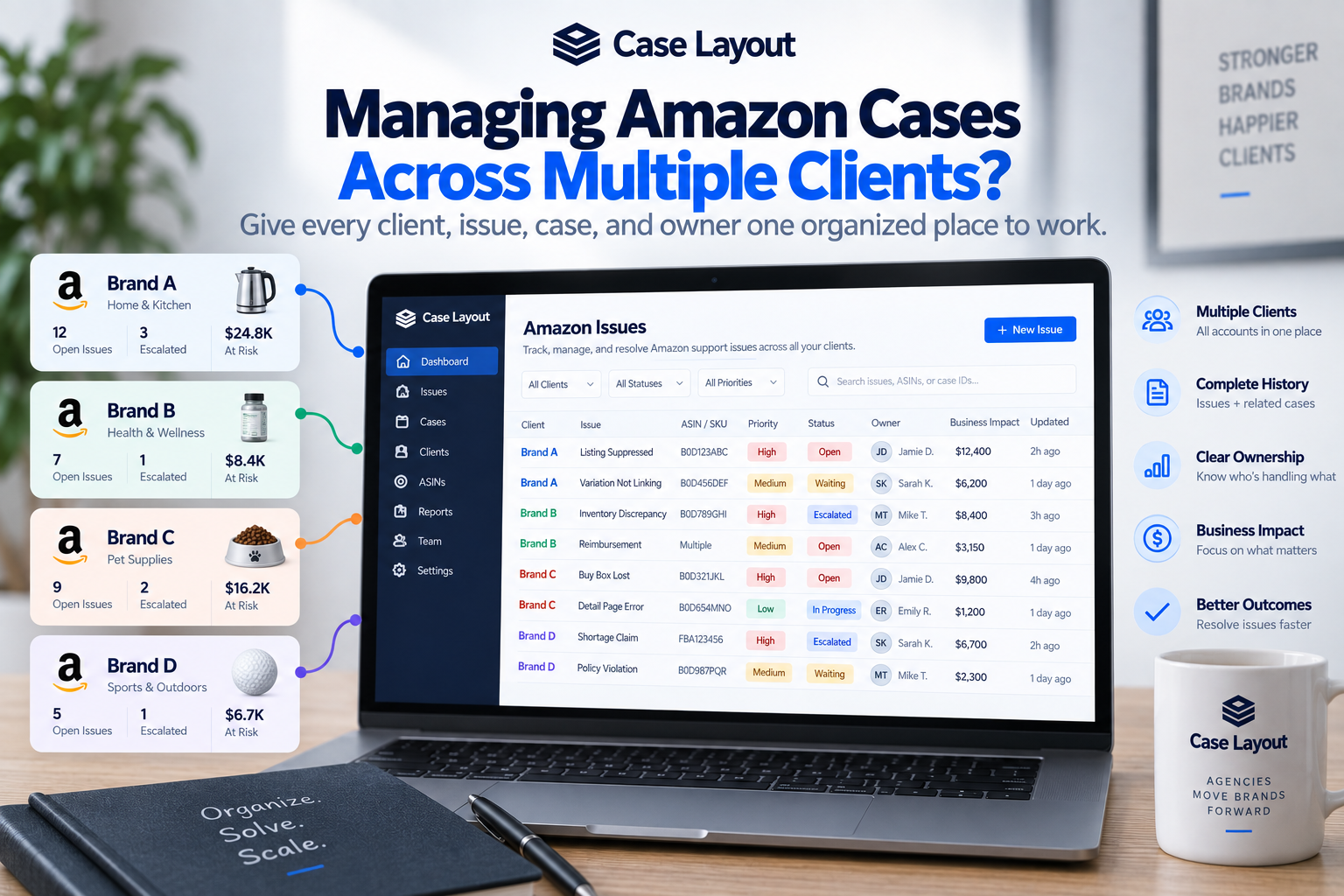
Managing Amazon support for one brand can be complicated.
Managing it across 10, 20, or 50 client accounts creates an entirely different operational challenge.
Each client has its own ASINs, catalog structure, inventory, financial issues, priorities, employees, and history with Amazon. At the same time, your agency may have several account managers, specialists, and team leads working across those businesses.
A listing suppression for one client may be a minor issue. For another, the same problem could affect its highest-volume ASIN and represent thousands of dollars in daily revenue.
Now add dozens of Amazon case IDs, follow-ups, screenshots, escalations, reimbursements, and internal conversations across the agency.
At that point, Amazon case management isn't simply an account-management task.
It's an agency operations problem.
Managing More Clients Multiplies the Complexity
An internal Amazon team generally has one major advantage: everyone is working toward the goals of the same business.
Agencies don't have that luxury.
Every client represents a separate business environment.
One client may have five active Amazon issues while another has 25. One account may primarily struggle with catalog problems while another generates frequent inventory or financial disputes.
The agency has to keep all of those histories separate while still maintaining a consistent internal process.
That creates several layers of organization:
- Client
- Brand
- Marketplace or account
- Business issue
- Amazon case
- ASIN or SKU
- Assigned employee
- Priority
- Business impact
- Status
- Next action
- Follow-up date
- Escalation history
- Final resolution
A spreadsheet can handle some of this information when an agency is small.
As the client roster grows, the relationships become increasingly difficult to manage.
Start With the Client, Then the Issue
Every Amazon issue should clearly belong to the correct client or brand.
That sounds obvious, but the internal structure matters.
Imagine your agency currently has 100 unresolved Amazon support cases across 15 clients.
A giant list of 100 case IDs isn't particularly useful.
Your account managers need to be able to see the issues relevant to the businesses they manage.
Leadership may need a completely different view.
An agency owner might want to know:
- Which clients currently have the most unresolved issues?
- Which accounts have the greatest business exposure?
- Which employees own the most active issues?
- Which issues have been open longest?
- Which problems are waiting on Amazon?
- Which clients have issues requiring escalation?
- Which problems have been resolved this month?
The underlying data may be the same, but different people need different ways to view it.
That's one reason a scalable agency process needs more structure than a simple list of Amazon case IDs.
Don't Make the Amazon Case the Primary Record
The same principle that applies to internal Amazon teams becomes even more important for agencies.
The Amazon case isn't necessarily the business issue.
Imagine one of your clients has a suppressed ASIN.
Your account manager opens an Amazon case.
Amazon closes it without fixing the problem.
A catalog specialist opens another case.
That case gets transferred.
Eventually, the account manager escalates the issue and another case is created.
Your agency now has three Amazon case IDs.
But your client still has one business problem:
A revenue-generating ASIN is suppressed.
If the agency tracks each Amazon case independently, the history becomes fragmented.
A better approach is to create one issue for the client and connect every related Amazon case to it.
The issue remains open until the underlying business problem is resolved.
Every Client Issue Needs an Owner
Agencies can easily create ownership confusion because multiple employees may work on the same account.
An account manager might oversee the client relationship while a catalog specialist handles listing problems. Another employee may manage reimbursements or inventory issues.
That structure is perfectly reasonable.
The problem appears when nobody knows who is ultimately responsible for moving an individual issue forward.
Every significant Amazon issue should have one primary owner.
Other employees can contribute, but one person should be accountable for the outcome.
That owner should be able to answer:
- What happened?
- Which client is affected?
- Which ASINs or SKUs are involved?
- Why does the issue matter?
- Which Amazon cases are connected?
- What has already been attempted?
- What are we waiting for?
- What needs to happen next?
- When should we follow up?
- What qualifies the issue as resolved?
Without clear ownership, an issue can sit unresolved while several people assume someone else is managing it.
Standardize the Workflow Across Account Managers
One of the biggest opportunities for an Amazon agency is creating consistency.
If every account manager has a different system for tracking support cases, the agency doesn't really have a case-management process.
It has several individual processes.
One employee may maintain a detailed spreadsheet.
Another may rely heavily on Amazon's case history.
Someone else may keep notes in a project-management platform.
Another person may remember most of the important details without documenting them anywhere.
That might work while those employees manage their own accounts.
It becomes a problem when leadership needs visibility or an account changes hands.
Agencies should establish a standard workflow for Amazon issues.
For example:
- Identified — The client issue has been discovered.
- Investigating — The agency is gathering information.
- Submitted to Amazon — A support case has been opened.
- Waiting on Amazon — Amazon needs to respond or take action.
- Client Action Required — Information or documentation is needed from the client.
- Agency Action Required — Someone internally needs to complete a task.
- Escalated — The normal support path hasn't resolved the problem.
- Verification Required — Amazon says the issue has been corrected.
- Resolved — The agency has confirmed the business problem is actually fixed.
The exact statuses can vary.
The important thing is that everyone follows the same basic operational process.
Track the Next Action for Every Open Issue
A status such as Waiting on Amazon is useful, but it isn't enough.
Every unresolved issue should have a next action.
For example:
- Follow up with Amazon tomorrow.
- Request documentation from the client.
- Check whether the ASIN has been restored.
- Escalate if Amazon doesn't respond by Friday.
- Verify the reimbursement.
- Review the issue with the catalog specialist.
- Confirm inventory quantities with the client.
This makes it much easier for account managers to begin their day.
Instead of scanning dozens of cases and trying to remember what needs attention, they can focus on issues with upcoming or overdue actions.
Follow-Up Dates Prevent Cases From Disappearing
Amazon agencies often manage enough simultaneous issues that relying on memory becomes dangerous.
An account manager responds to Amazon and moves on to another task.
Three days later, the case hasn't received a meaningful response.
But the employee is now managing 20 other priorities.
The original issue quietly sits unresolved.
A follow-up date solves a surprisingly large part of this problem.
Whenever an issue enters a waiting state, decide when someone should review it again.
High-impact issues may require frequent follow-up.
Lower-priority issues may reasonably wait longer.
The exact timing will vary, but the issue shouldn't be left open indefinitely without a planned next review.
Preserve the Complete Client History
Amazon account history becomes extremely valuable over time.
An agency may manage the same client for several years.
During that period, the account can generate hundreds or thousands of support interactions.
Some problems will repeat.
A variation that broke last year may break again.
A product may experience another suppression.
A similar inventory discrepancy may appear.
If the previous history is accessible, the agency starts with an advantage.
The team can see:
- What happened previously
- Which Amazon cases were opened
- What documentation was requested
- Which approaches failed
- How the issue was escalated
- What ultimately solved the problem
Instead of treating every new Amazon problem as a blank slate, the agency can use its previous work as a playbook.
Account Transitions Shouldn't Erase History
This may be one of the biggest benefits for agencies.
Clients sometimes move from one account manager to another.
Employees get promoted.
Responsibilities change.
People leave the company.
When case history primarily lives inside the account manager's memory, every transition creates risk.
Imagine a new employee takes over a client that your agency has managed for three years.
They inherit the Amazon account, but do they inherit the knowledge?
Do they know that a particular ASIN has been suppressed three times?
Do they know how the agency fixed a difficult variation problem last year?
Do they know about an unresolved financial dispute from two months ago?
Do they know which escalation paths have worked previously?
If the answer depends on a handoff meeting with the previous account manager, the agency doesn't truly own its institutional knowledge.
The history should belong to the agency, not the employee.
Client Requests Shouldn't Live Only in Email
Agencies also have another layer of communication that internal Amazon teams don't always face.
The client may be providing information, requesting updates, sending screenshots, or supplying documentation.
If those interactions exist only in email, the complete history of the Amazon issue can become difficult to reconstruct.
Imagine an Amazon case requires documentation from the client.
The account manager requests it by email.
The client responds two days later.
The account manager submits the file to Amazon.
Amazon responds a week later.
Another agency employee eventually takes over the issue.
That employee now needs to search through both Amazon and email to understand what happened.
Important client-provided information should become part of the issue history when appropriate.
The goal isn't to replace email.
It's to prevent critical information from existing only inside someone's inbox.
Prioritize by Client Impact, Not Just Case Age
Agencies also need a consistent way to determine which issues deserve attention first.
The oldest case isn't necessarily the most important.
Consider two issues.
Client A has a catalog correction that has been open for eight days but has little effect on sales.
Client B has a top-selling ASIN that became suppressed yesterday.
The newer issue may deserve immediate attention.
Priority can consider factors such as:
- Estimated revenue exposure
- Financial amount involved
- Number of affected ASINs
- Inventory impact
- Customer impact
- Account or compliance risk
- Strategic importance of the product
- Length of time unresolved
This gives account managers a better way to allocate their time.
Case Management Can Improve Client Reporting
Amazon agencies do a significant amount of work that clients never see.
A complicated listing issue may require multiple Amazon cases, several follow-ups, screenshots, documentation, escalation, and hours of investigation.
The client may only see the final result:
The listing is fixed.
That's good from the client's perspective, but it can make the agency's work less visible.
Structured issue history creates an opportunity to communicate that value more clearly.
Instead of reporting:
"We worked on Amazon support cases this month."
The agency can report:
"We resolved 14 Amazon business issues, including three listing suppressions, four catalog problems, two inventory discrepancies, and $8,500 in financial issues."
The exact metrics will depend on what the agency tracks, but the principle is important.
Report business outcomes, not just support activity.
Business Reviews Become More Meaningful
This information can also improve monthly or quarterly client reviews.
Instead of manually reconstructing Amazon support activity, the agency can discuss:
- Issues opened
- Issues resolved
- Issues still outstanding
- Average time to resolution
- Financial amounts recovered
- Revenue-impacting issues addressed
- Recurring problems
- Escalations
- High-priority unresolved issues
This can turn Amazon case management into a visible part of the agency's value proposition.
You're not simply opening support cases on behalf of the client.
You're actively managing Amazon operational problems through resolution.
Agencies Can Learn Across Clients
There is another advantage agencies have that individual brands don't.
An agency may encounter the same type of Amazon problem across many different accounts.
That creates an enormous opportunity for institutional learning.
If your team has solved similar variation problems for 15 clients, you may begin recognizing patterns much faster than an individual brand would.
The same could be true for listing suppressions, inventory discrepancies, reimbursements, or other recurring issues.
Of course, every account is different and information should remain appropriately separated between clients.
But the agency's operational experience compounds.
Your employees get better at recognizing problems, knowing what information Amazon may request, and understanding which escalation approaches have worked in similar situations.
A structured case-management process helps preserve that knowledge.
Leadership Needs an Agency-Level View
Account managers need detailed information about their clients.
Agency leadership needs a broader view.
Leadership should be able to understand questions such as:
- How many unresolved issues exist across all clients?
- Which clients currently have the most high-priority issues?
- Which account managers have the largest active workloads?
- Which issues have been open longest?
- Which categories occur most frequently?
- How many issues were resolved this month?
- Which problems repeatedly require escalation?
- Where are there potential client risks?
This can help with staffing, workload balancing, training, process improvement, and client retention.
It also makes it easier to identify when an account manager may need additional support before problems begin affecting the client relationship.
Don't Measure Agency Performance by Number of Cases Opened
More Amazon cases don't necessarily mean more work is being accomplished.
In some situations, opening several cases for the same issue may actually indicate that the problem has been difficult to resolve.
That's why agencies should be cautious about using raw case volume as a performance metric.
More useful metrics might include:
- Number of business issues resolved
- Average time to resolution
- High-priority issues resolved
- Financial amounts recovered
- Issues resolved without escalation
- Average number of cases required per issue
- Recurring issue rate
- Age of unresolved issues
These metrics focus more closely on outcomes.
Build a Process That Scales With the Agency
A small agency with three clients can manage Amazon cases almost any way it wants.
Everyone probably knows what's happening.
As the agency grows to 10, 25, 50, or more clients, informal processes become increasingly difficult to maintain.
The solution isn't necessarily more meetings, more spreadsheets, or more internal messages.
It's creating a consistent system where everyone knows:
- Where Amazon issues are tracked
- Who owns each issue
- Which cases are connected
- What has already happened
- What needs to happen next
- When follow-up is required
- When escalation is appropriate
- Whether the final outcome was verified
That creates a process that can continue working as the agency adds employees and clients.
Give Every Client's Amazon Issues a Complete History
This is one of the reasons we built Case Layout.
Amazon agencies aren't simply managing case numbers. They're managing business problems across multiple clients, brands, employees, and Amazon support interactions.
Case Layout gives agencies a centralized place to organize each client's underlying issues, connect related Amazon cases, assign ownership, track priorities and follow-ups, preserve documentation, and maintain the complete history through verified resolution.
Instead of every account manager developing their own case-tracking process, the agency can create a consistent operational system across the organization.
That can make account transitions easier, client reporting clearer, leadership visibility stronger, and recurring Amazon problems faster to understand.
Because as an agency grows, the question isn't simply whether your team can manage more Amazon cases.
It's whether your process can scale without losing track of the clients, issues, history, and outcomes behind them.