
Amazon Case Management: Cases Aren't the Problem — Issues Are
9/13/2026
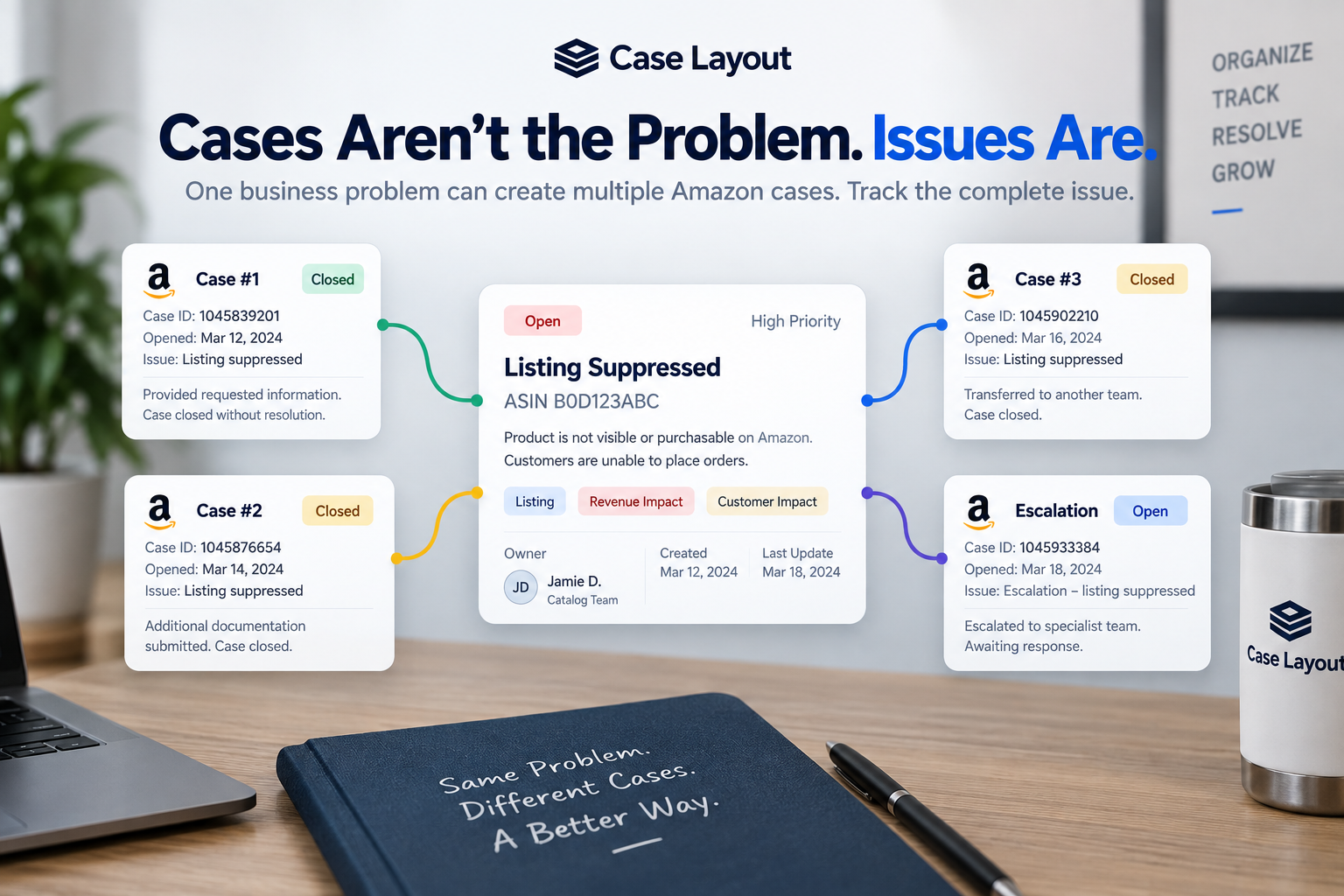
Amazon assigns a case ID every time you open a support case. Because of that, the case naturally becomes the thing most Amazon teams track.
You put the case number in a spreadsheet. You assign it to someone. You add a status. When Amazon closes the case, you mark the row closed and move on.
There's just one problem with that approach: the Amazon case isn't usually the problem your business is trying to solve.
The case is simply one interaction with Amazon during the process of solving a larger business issue.
That distinction may sound small, but it can fundamentally change how an Amazon team manages support.
Think About the Business Problem First
Imagine one of your most important parent-child variations suddenly breaks.
Several child ASINs are no longer displaying together correctly, customers aren't seeing the product family the way they should, and your team needs Amazon to correct the relationship.
You open a support case.
Amazon responds and asks for additional information. Your team provides it. Another support associate responds, but the variation still isn't fixed. Eventually, the case is closed.
So your team opens another case.
The second case references the first one and includes additional documentation. It gets transferred to another Amazon team. After several messages, that case also closes without fully resolving the problem.
Someone on your team eventually escalates the issue and another case is created.
You now have three Amazon case IDs.
If your internal tracking system is organized around cases, you may have three separate records.
But your business doesn't have three problems.
You have one problem: the variation is broken.
The business outcome you're trying to achieve hasn't changed just because Amazon generated another case number.
One Issue Can Have Multiple Amazon Cases
This is one of the fundamental challenges with tracking Amazon support.
The relationship between a business issue and an Amazon support case isn't always one-to-one.
A relatively simple problem might require only one case. More complicated problems can require several.
An issue could involve:
- An initial Amazon support case
- A second case after the first one is closed
- A case opened with another Amazon support team
- An escalation
- A related reimbursement case
- Additional cases involving other affected ASINs
Those support interactions may all exist because of one underlying business problem.
Treating each case as a separate issue fragments the history.
Someone reviewing the problem later has to figure out which cases belong together, what happened in each one, and how they relate to the final outcome.
The more cases involved, the more difficult that becomes.
The Issue Should Be the Primary Record
A better way to think about Amazon case management is to make the underlying business issue the primary record.
Instead of starting with:
Case #123456789
Start with:
Variation Broken — 12-Pack Product Family
Or:
ASIN B0XXXXXX — Listing Suppressed
Or:
Inbound Shipment — Inventory Discrepancy
Or:
Shortage Claim — $18,400 in Dispute
The issue describes what your business actually needs to solve.
The Amazon cases then become part of that issue's history.
Your issue record might contain:
- Issue title
- Affected ASINs or SKUs
- Date discovered
- Assigned owner
- Business impact
- Priority
- Related Amazon case IDs
- Amazon responses
- Screenshots
- Supporting documentation
- Internal notes
- Actions already attempted
- Escalation history
- Current status
- Next action
- Follow-up date
- Final resolution
Now your team has one place to understand the complete problem, regardless of how many Amazon support cases are required to resolve it.
Cases Are Events. Issues Have Lifecycles.
This is another useful way to think about the difference.
Amazon cases are events. Business issues have lifecycles.
A support case might be opened on Monday and closed on Wednesday.
The underlying business issue might remain unresolved for three weeks.
During those three weeks, your team may investigate internally, communicate with Amazon, provide documentation, open another case, escalate the problem, make requested changes, wait for Amazon to take action, and eventually verify that the problem has been corrected.
That's the lifecycle of the issue.
A typical issue might move through stages such as:
- Identified — Your team discovers the problem.
- Investigating — You determine what's happening and gather information.
- Submitted to Amazon — The first support case is opened.
- Waiting on Amazon — Amazon needs to respond or take action.
- Action Required — Your team needs to provide additional information.
- Escalated — The original support path hasn't resolved the issue.
- Verification Required — Amazon says the correction has been made.
- Resolved — Your team verifies that the underlying business problem is actually fixed.
Several Amazon cases can open and close during this lifecycle.
The issue remains open until the business outcome is achieved.
Amazon Closing a Case Shouldn't Automatically Close the Issue
This distinction becomes especially important when Amazon closes a support case.
Suppose Amazon responds:
"We've reviewed your request and made the appropriate changes."
The case closes.
If your internal tracking is based entirely on Amazon's case status, someone may mark the problem resolved.
But did anyone actually check?
If the issue involved a suppressed listing, open the detail page and confirm the product is purchasable.
If it involved a variation, confirm the parent-child relationship is displaying correctly.
If it involved inventory, verify that the expected inventory is available.
If it involved a reimbursement, confirm that the money was actually received.
If the expected business outcome hasn't occurred, the issue isn't resolved.
Amazon may have closed its support interaction, but your business still has a problem.
Multiple Cases Should Tell One Story
Imagine someone new joins your Amazon team six months after a complicated issue was resolved.
The same problem happens again.
They search your historical case tracker and find four Amazon case IDs related to the ASIN.
Now they have to determine which case came first, which cases were related, what Amazon said in each case, which approaches failed, which case finally led to the solution, and what actually fixed the problem.
That's a lot of reconstruction.
Now imagine the alternative.
They search the ASIN and find one historical issue:
ASIN B0XXXXXX — Listing Suppressed
Inside that issue are four related Amazon cases, the complete history, internal notes, documentation, escalation activity, and the final resolution.
Within a few minutes, the new employee understands what happened.
That's the value of organizing information around the issue.
Several support conversations become one continuous business story.
Issue-Based Tracking Makes Recurring Problems Easier to Identify
Amazon problems don't always happen once.
The same ASIN may experience repeated listing problems. A product family may have recurring variation issues. Similar inventory discrepancies may appear several times throughout the year.
If every event exists only as an individual Amazon case, those patterns can be difficult to recognize.
Issue-based tracking creates a clearer historical record.
Your team can begin asking questions such as:
- Has this ASIN experienced this problem before?
- How many times has this type of issue occurred?
- How many Amazon cases were required to resolve it previously?
- Which escalation eventually worked?
- Is the same root cause creating multiple issues?
- Are supposedly resolved problems returning?
Those questions move Amazon support beyond case administration and toward operational improvement.
The Difference Matters for Financial Issues Too
The case-versus-issue distinction isn't limited to catalog problems.
It can be even more important when money is involved.
Imagine your business is pursuing a significant reimbursement or shortage claim.
Several Amazon cases may be required during the process.
One case might investigate the discrepancy. Another might involve supporting documentation. A later case could involve the reimbursement itself.
If your team treats each one as a separate record, it becomes harder to answer the question that matters most:
Did we recover the money?
The underlying issue should remain open until the financial outcome is verified.
Amazon closing one of the associated cases shouldn't determine whether your organization considers the matter resolved.
Issue Management Improves Ownership
Organizing around issues also makes accountability clearer.
If three Amazon cases belong to the same business problem, you don't necessarily want three different people independently managing them without understanding the larger situation.
The issue should have one primary owner.
Other employees can contribute, but one person should be accountable for moving the complete problem toward resolution.
That owner should understand:
- Why the issue matters
- Which cases are related
- What has already been attempted
- What Amazon has said
- What needs to happen next
- When to follow up
- When escalation is appropriate
- What outcome qualifies as resolved
This prevents support activity from becoming disconnected simply because several case IDs exist.
Issue Management Creates Better Leadership Visibility
Leadership usually doesn't care about Amazon case IDs.
They care about business problems.
A senior leader is unlikely to ask:
"What's happening with Case #123456789?"
They're much more likely to ask:
"Why is our top ASIN still suppressed?"
Or:
"Have we recovered that $25,000 shortage?"
Or:
"Why does this variation keep breaking?"
That's another reason issue-based tracking makes more sense.
It organizes Amazon support around the same outcomes the business actually cares about.
Instead of reporting that your team has 37 open Amazon cases, you can provide a clearer picture of the unresolved issues affecting the business, their priority, their owners, and their current status.
Historical Issues Become Institutional Knowledge
The long-term value of issue-based tracking may be even greater than the immediate organizational benefit.
Every resolved Amazon issue contains knowledge.
Your team learned something about the account.
You learned what Amazon requested, which documentation worked, which escalation path succeeded, which solutions failed, and what ultimately corrected the problem.
If that knowledge remains buried inside individual Amazon case conversations, it's difficult to reuse.
If it's organized around a searchable issue, it becomes part of your organization's operational history.
The next time the problem happens, your team doesn't have to start from zero.
They can start with what the company already knows.
Change the Questions Your Team Asks
Once you start thinking in terms of issues rather than cases, the questions your team asks begin to change.
Instead of asking:
"How many Amazon cases are open?"
Ask:
"How many business issues remain unresolved?"
Instead of asking:
"Why did someone open another case?"
Ask:
"Is this new case related to an existing issue?"
Instead of asking:
"Did Amazon close the case?"
Ask:
"Did Amazon actually fix the problem?"
Instead of asking:
"Where is the previous case?"
Ask:
"What happened the last time we had this issue?"
Those questions create a very different support process.
Manage the Issue, Not Just the Case
This concept is at the center of Case Layout.
After years of managing e-commerce and marketplace businesses, I kept seeing the same problem: Amazon support cases were being tracked, but the underlying business issue wasn't always being managed as one continuous problem.
A listing issue could generate several cases. Screenshots might live in one place, Amazon responses in another, internal conversations somewhere else, and the complete history in the memory of the employee who happened to manage it.
Case Layout was built around a different structure.
The issue is the primary record.
Amazon cases can be connected to that issue along with the affected ASINs, ownership, priority, documentation, internal history, follow-ups, escalation activity, and final resolution.
The result isn't simply a better place to store Amazon case numbers.
It's a way to preserve the complete history of the business problems your Amazon team is working to solve.
Because your company doesn't lose revenue because an Amazon case exists.
It loses revenue because the underlying issue remains unresolved.