
The True Cost of an Unresolved Amazon Support Case
9/13/2026
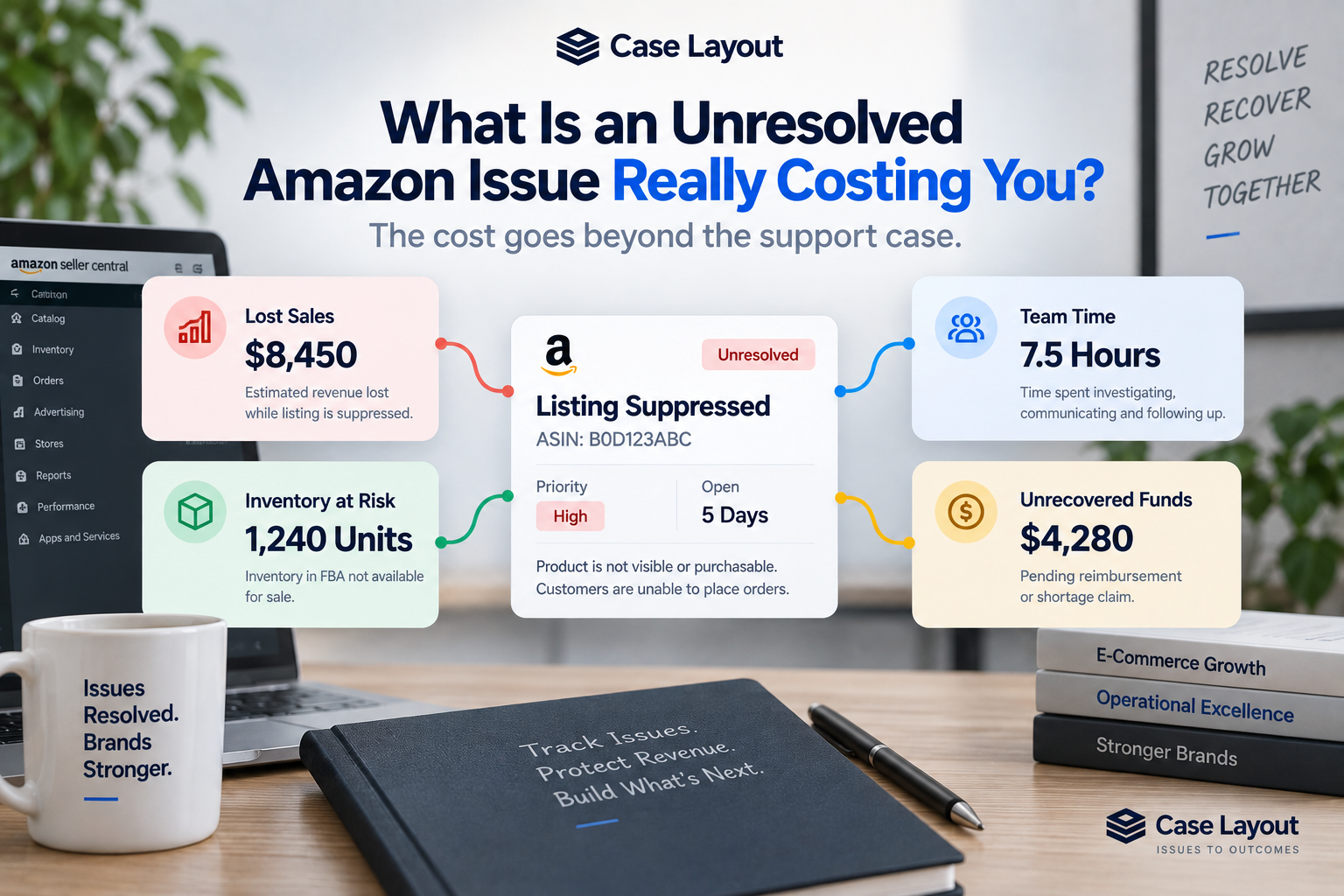
When businesses think about Amazon support cases, they often treat them as administrative work. Something goes wrong, someone on the e-commerce team opens a case, Amazon responds, the team follows up, and eventually the case is closed.
But the time spent communicating with Amazon is rarely the biggest cost of an unresolved issue.
A suppressed listing can mean lost sales every hour it remains unavailable. An inventory discrepancy can prevent products from being sold. A shortage or reimbursement issue can leave money unrecovered. Employees can spend hours reconstructing case history, gathering documentation, and repeating work that someone else already completed.
The real question isn't simply "How long has this Amazon case been open?"
It's "What is this unresolved business problem costing us while it remains open?"
Amazon Support Issues Can Have Real Financial Impact
Not every Amazon case represents a major financial problem.
Some issues are simple catalog corrections or administrative requests that have little immediate effect on the business.
Others can directly affect revenue, inventory, cash flow, profitability, and customer experience.
Imagine one of your top-selling ASINs becomes suppressed.
Your team opens an Amazon support case immediately. Amazon responds the next day requesting additional information. Your team provides it, but the listing remains unavailable. The case is transferred to another support team. Several days pass before the issue is finally corrected.
From a case-management perspective, you had an Amazon support case open for several days.
From a business perspective, you had a revenue-generating product unavailable for several days.
Those are two very different ways to measure the same event.
Lost Sales Can Add Up Quickly
Listing suppressions are one of the clearest examples of the financial impact associated with unresolved Amazon issues.
Suppose an ASIN normally generates $2,000 in sales per day.
If that product becomes unavailable for five days, the potential revenue exposure is:
$2,000 × 5 days = $10,000
That doesn't necessarily mean the business permanently lost exactly $10,000. Some customers may purchase later, choose another product from your brand, or shift their purchase to another channel.
But it does demonstrate why the age of an Amazon issue matters.
The longer an important product remains unavailable, the greater the potential business impact.
Now consider a larger product generating $10,000 per day.
A five-day suppression creates potential revenue exposure of $50,000.
Suddenly, what looks like "one open Amazon case" becomes a significant business problem.
This is why case volume alone isn't enough to understand Amazon operational risk.
Ten low-impact cases may matter less than one unresolved issue affecting your highest-volume ASIN.
Not All Amazon Cases Should Have the Same Priority
Many Amazon case trackers treat every support case roughly the same.
A spreadsheet may contain columns for case ID, date opened, owner, and status. Every open case becomes another row.
But the business impact behind those rows can be dramatically different.
Consider these two issues:
Issue A: A minor bullet-point correction on a low-volume ASIN.
Issue B: Your highest-volume product has been suppressed and isn't available for purchase.
Both may require an Amazon support case.
They should not have the same priority.
A stronger case-management process should consider factors such as:
- Estimated revenue exposure
- Financial amount in dispute
- Number of affected ASINs
- Inventory impact
- Customer impact
- Account or compliance risk
- Strategic importance of the product
- Length of time unresolved
These factors help your team focus attention where the business impact is greatest.
Inventory Problems Create Another Layer of Cost
Revenue isn't the only consideration.
Amazon inventory issues can create significant operational problems even when a listing remains active.
Inventory may become stranded or unavailable. Units may be incorrectly recorded. Inbound shipments may contain discrepancies. Products may exist physically within Amazon's network while your company can't sell them.
Consider a business with 1,000 units of inventory affected by an unresolved issue.
Those units represent capital your company has already invested.
You paid to manufacture or purchase the product. You may have paid to transport it. Amazon may physically possess the inventory.
But if customers can't purchase those units, that capital isn't producing revenue.
The longer the inventory remains unavailable, the longer your investment remains tied up.
For seasonal products, the consequences can be even greater. Solving an inventory problem three weeks later may not help if the most important selling period has already passed.
Reimbursements Should Be Tracked Through Actual Recovery
Financial disputes create another common problem.
Amazon may acknowledge that your business is owed money, but that doesn't necessarily mean the issue should immediately be considered resolved.
Suppose your company is pursuing a $7,500 reimbursement.
Your team opens a support case, provides documentation, and Amazon eventually confirms that the reimbursement has been approved.
The case closes.
Is the business issue resolved?
Not necessarily.
Someone should verify that the expected amount was actually received.
The same principle applies to shortage claims and other financial disputes.
Your internal issue should ideally track:
- Amount originally disputed
- Amount approved
- Amount actually recovered
- Related Amazon case IDs
- Date reimbursement was expected
- Date reimbursement was received
- Remaining financial exposure
Until the expected financial outcome occurs, your organization may still have an unresolved issue even if Amazon has closed the associated support case.
Employee Time Is Part of the Cost
One of the least visible costs of Amazon support is employee time.
Consider what happens when an issue has been open for several weeks.
An employee checks the original Amazon case.
Another person searches the spreadsheet for an update.
Someone asks a coworker what happened.
Finance looks for documentation.
The account manager reviews several Amazon responses.
Someone searches email or Slack for an old conversation.
A meeting gets scheduled so everyone can get caught up.
None of those activities individually seem significant.
But they add up.
Imagine three employees each spend 30 minutes simply reconstructing the history of an Amazon issue.
That's 90 minutes of employee time spent understanding the problem before anyone even begins working on the next solution.
Multiply that across dozens or hundreds of issues every year and the operational cost becomes meaningful.
Repeated Investigation Is Expensive
The cost becomes even greater when the same Amazon problem happens again.
Imagine your team spent six hours solving a difficult variation problem last year.
Several cases were opened. Documentation was submitted. Multiple approaches were attempted. Eventually, someone found the solution.
Eight months later, the same variation breaks again.
If the previous history isn't easily accessible, the new employee investigating the issue may repeat much of the same work.
They may try solutions that already failed.
They may submit the same documentation.
They may open several cases before discovering the same escalation path the previous employee used.
Your organization already paid to learn how to solve the problem once.
Without structured history, you may pay to learn it again.
Case History Can Reduce the Cost of Recurring Problems
This is where historical issue tracking becomes valuable.
Imagine the same variation problem occurs, but this time your team can immediately find the previous issue.
They can see:
- Which ASINs were affected
- Which Amazon cases were opened
- What Amazon originally said
- Which documentation was requested
- Which solutions were attempted
- Which approaches failed
- How the issue was escalated
- What ultimately resolved it
The previous issue doesn't guarantee an immediate solution, but it gives the team a much better starting point.
Instead of beginning with zero knowledge, they begin with everything the organization already learned.
Historical Amazon support data can become an operational asset.
Recurring Problems May Reveal a Bigger Issue
There is another reason to preserve issue history.
Sometimes the real problem isn't the individual Amazon case.
It's that the same problem keeps happening.
Suppose one ASIN experiences a listing suppression four times in a year.
Your team could treat those as four unrelated Amazon support cases.
Or you could look at the history and ask a more important question:
Why does this keep happening?
Maybe there is a recurring catalog-data problem.
Perhaps information is being overwritten by another contributor.
Maybe an internal process is repeatedly introducing incorrect data.
The same principle applies to inventory discrepancies, shortage claims, variation issues, and other operational problems.
Once historical issues are connected and searchable, patterns become easier to recognize.
At that point, Amazon case management can move beyond reacting to individual problems and start helping the organization identify root causes.
Track Business Impact Alongside Case Status
Amazon teams don't need to create complex financial models for every support case.
But significant issues should include some measure of business impact.
Depending on the problem, that could include:
- Estimated daily sales affected
- Estimated revenue exposure
- Financial amount in dispute
- Inventory units affected
- Inventory value affected
- Number of ASINs involved
- Employee hours spent
- Number of related Amazon cases
- Number of days unresolved
Even approximate information can help the organization prioritize.
Imagine your team has 25 unresolved Amazon issues.
Without business-impact information, leadership sees 25 problems.
With impact information, the picture becomes clearer.
Perhaps three issues represent the majority of the financial exposure.
Those three issues should probably receive the greatest attention.
Time to Resolution Matters
Another useful metric is time to resolution.
It's easy to measure how many Amazon cases your team opens and closes.
But case volume doesn't necessarily tell you whether your support process is effective.
Consider two teams.
Team A opens 200 Amazon cases in a quarter.
Team B opens 120.
Which team is performing better?
There isn't enough information to know.
Team A could be extremely efficient, or it could be repeatedly opening new cases because problems aren't being resolved.
A more useful set of questions might include:
- How long does the average business issue remain unresolved?
- Which types of issues take longest to resolve?
- How many cases are typically required per issue?
- Which issues require escalation?
- How often do supposedly resolved problems return?
- How much money is recovered through financial issues?
- How much revenue exposure is associated with unresolved problems?
Those metrics begin connecting Amazon support activity with business performance.
Closed Cases Can Create a False Sense of Completion
One of the biggest reasons financial impact gets overlooked is that a closed Amazon case feels like completed work.
The support conversation is finished.
The case disappears from the active queue.
The employee moves to the next task.
But the business outcome may still be unresolved.
This is why your organization should maintain its own issue status.
Amazon may mark a case closed while your internal issue moves to:
Verification Required
Someone then checks the actual outcome.
Was the listing restored?
Was the inventory corrected?
Did the reimbursement arrive?
Was the variation repaired?
Only after that verification should the business issue move to Resolved.
Think About Amazon Support as Business Operations
Amazon support cases shouldn't exist in a separate administrative universe.
The issues behind them are part of running the business.
A suppressed listing is a sales problem.
Missing inventory is an operations problem.
An unrecovered reimbursement is a financial problem.
A compliance issue can become an account-risk problem.
A broken variation can become a conversion and customer-experience problem.
The Amazon case is simply one mechanism your team uses to resolve those problems.
Thinking about support this way changes the conversation from:
"How many cases are open?"
to:
"Which unresolved issues are currently affecting the business?"
That's a much more useful question.
What Is an Unresolved Amazon Issue Really Costing You?
The true cost of an unresolved Amazon support issue isn't simply the time required to open and manage the case.
It may include lost sales, unavailable inventory, unrecovered money, employee labor, repeated investigation, delayed decisions, and recurring problems that your organization hasn't identified yet.
That's why the underlying issue should remain the focus.
This is one of the ideas behind Case Layout.
Case Layout gives Amazon teams a centralized place to organize the business problem, connect related Amazon cases, assign ownership, preserve documentation, maintain the complete history, and track the issue through actual resolution.
Instead of seeing a list of support case IDs, your team can begin building a record of what went wrong, what it affected, what was done about it, and whether the business impact was ultimately resolved.
Because the most important number associated with an Amazon support problem usually isn't the case ID.
It's what that unresolved issue is costing your business.